

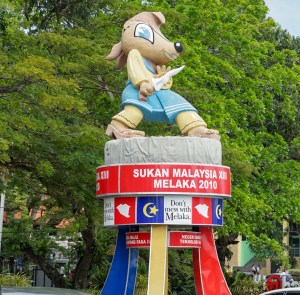
 Is it Malacca or Melaka? I wasn’t sure about this even as my bus got there from KL. You’ll find them used interchangeably all over the place. Apparently one version is the English version and the other is Malay. In order to provide some sort of clarity the state government decried last year that official correspondence would use Melaka¹. So Melaka it is. Maybe this is why there are aggressive looking Don’t Mess with Melaka signs all over the place? It’s not, it is part of an anti-littering campaign.
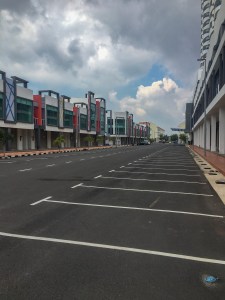
Arriving at the hostel I had booked, I could swear that I was stepping into the scene of some postapocalyptic movie. For several blocks spreading from where I was staying to the edge of the old-city there were brand new buildings that were essentially empty. It was all a bit eery, but at least the place I was staying at was really nice and I got told that I looked like Matt Damon. That’s a complement, right?
Having learned a bit about the region while at the National Museum in KL, I was looking forward to exploring the old city and its history. Melaka was initially a fishing village, but it became an important trading and refueling port for Chinese traders navigating the straits. By the 15th century it was ruled by the Sultanate of Melaka. After years of holding them off the region fell to the Portuguese in the 16th century and then was taken over by the Dutch in the 18th century, and finally the British in the 19th century. The British governed it as part of the Straits settlements, along with Penang and Singapore, until it fell to the Japanese in WWII. After the war it became part of the British run Malaysia and it was here where in 1956 it was announced that Malaysia would become an independent country in 1957. The mixture of cultures and its storied history, led the region to be declared a UNESCO site in 2008².
I entered Chinatown and walked down Jonker street, which is where there are a lot of cool shops and restaurants only to find at the other end an H&M on one side of the street and a Hard Rock Cafe on the other. Never did find a Rolex store though.


Crossing the river you find a number of bright red buildings, which were apparently the influence of the Dutch and a central square which has a fountain that was commemorated in honour of Queen Victoria’s Diamond Jubilee. There were also buskiers singing western music near the square. So in addition to Thai Elvis (Bangkok), and Malaysian Johnny Cash (KL), I’ve now seen Malaysian Bono and Hank Williams.


Dodging a number of crazily decorated tuk-tuks playing really loud music I made way to the centre of the city and climbed the hill to the old church ruins, which gives a pretty spectacular view of the city. From here I meandered back along the river and to the hostel, which was as equally empty as when I left.


Melaka also has a really interesting food scene owing to its mixture of cultures. I had a pretty delicious Portuguese noodle dish and curry the day before I left.
I really don’t think I did Melaka justice and probably should have spent another day exploring the nearby areas and some more of the museums, but I had promised I’d be in Singapore by the 23rd and it was time to move on.
Having found a bus that would take me to a mall downtown Singapore, the same mall which apparently houses the North Korean Embassy on one of its upper floors, I set off to the bus station. Little did I know that this 4 h bus trip would end up being closer to 8 h.
Links:
1: http://www.straitstimes.com/asia/se-asia/malacca-now-known-as-melaka-says-state-government
 The Travelling Scientist